
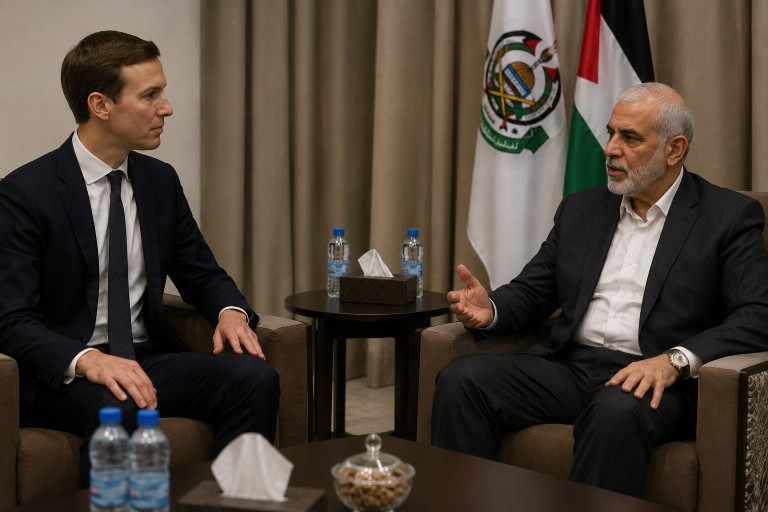
In a renewed diplomatic effort by the United States, Jared Kushner, senior advisor and son-in-law to former President Donald Trump, met with Khalil al-Hayya, the political leader of Hamas, in Egypt on Sunday. This meeting is part of an initiative to revive a stalled ceasefire plan in Gaza. The discussions come ahead of Kushner’s scheduled meeting with Israeli Prime Minister Benjamin Netanyahu, who has recently dismissed a US-backed 15-point plan aimed at advancing the ceasefire.
The proposed plan outlines a gradual disarmament of Hamas, in exchange for Israel halting its military operations and withdrawing from certain areas of Gaza. It also includes provisions for reconstruction and the involvement of international forces to ensure security. While Hamas has shown willingness to adhere to the road map, they demand that Israel cease its attacks and retreat to a predefined “yellow line” prior to the plan’s execution. Additionally, Hamas has linked the disarmament of its heavier weaponry to advancements towards establishing a Palestinian state, a notion that Netanyahu’s administration opposes.
Prime Minister Netanyahu has maintained that a complete withdrawal of Israeli forces from Gaza is contingent upon the total disarmament of Hamas. This stalemate has hindered progress on essential components of the ceasefire plan, including reconstruction efforts and the deployment of international peacekeeping forces. Kushner’s meeting, attended by officials from Egypt, Qatar, and Turkey, focused on securing Hamas’s commitment to disarmament ahead of his discussions with Netanyahu.
In addition to his talks with Netanyahu, Kushner is set to meet with former British Prime Minister Tony Blair and Nickolay Mladenov, director of the Board of Peace. The refusal of Israel to accept the US-backed plan has drawn criticism from several regional nations, including Saudi Arabia, the United Arab Emirates, Jordan, Pakistan, and Indonesia, all of whom have called for immediate measures to avoid further delays in the peace process.
This diplomatic initiative unfolds as Netanyahu faces increasing political pressure leading up to Israel’s October election. His governing coalition includes ministers who advocate for a more stringent approach to Gaza, casting uncertainty on the future of the ceasefire proposal. The international community is keenly observing these developments, as the potential for peace in the region hangs in the balance.